
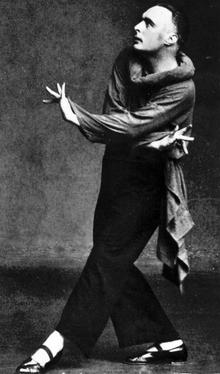
 Rudolf Laban, was a teacher, who experimented “with movement choirs, theories of movement” [1] that would create a form of modern dance notation that allowed choreographers too keep a note down on what their movement phrases are. But he also founded a dance called the “Ausdruckstanz”. This is the dance of feeling or expression.
The one thing he kept devoted on was that if dance “can not lift itself out of being bottom of the pile in terms of hierarchy and significance of the arts.” This would go and inspire two of his students, Mary Wigman and Kurt Jooss.
Mary Wigman created two dances called “Witch Dance”, one in 1914 and another in 1929. Both of them uses this idea of separating dance and music. In the 1914 dance, she danced with no music, which had not been done before then. But in the 1929 one, she had a musical accompaniment of drums that was following her movements rather than her following the music, which changed the relationship for some forms of the modern dance.
Kurt Jooss followed with Laban’s methods however as he also trained in ballet, he used some techniques of that too create political theater. His famous productions would have been the “Green Table” which he created in 1932. It was an Anti-war piece that won “the first international award for choreography” [1] that told a story that if we keep going we will end up back in war.
Rudolf Laban was inspired and influenced by “the social and cultural changes of time” [6] that Isadora allowed the dance world to have. To have “men and women dancing barefoot and in little clothing” [6] in contrast too ballet. Laban developed contemporary dance by coming up with a way to write down movement material, and also coming up with the idea that dance can become more significant if if breaks itself from music.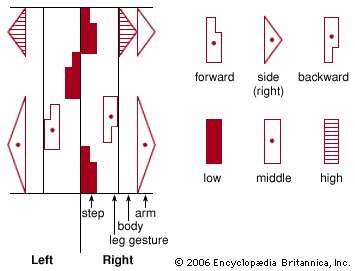
Information gained from Bibliography:
[1]
[6]
 Callum Dance Blog